In short: Upright’s across-asset-class methodology makes it possible to measure the net impact of an entire financial organization’s investments.
To put this to the test, I calculated impact scores using The Upright Project‘s publicly accessible fund database and used them as my running checkpoints, from lowest to highest net impact ratio. You can see the results https://lnkd.in/dz49Dvgy. If the numbers raise any thoughts or questions, I’d love to explore them with you.
Some highlights from the run:
1. Security guards were often very confused. Apparently, runners taking selfies in front of financial institutions isn’t a common sight.
2. I spotted actor Brian Cox mid-run. I’d have said hello, but he was heading to a movie premiere and didn’t seem in the mood to discuss sustainable investing. Maybe another time.
3. You’d think finding giant skyscrapers would be easy, but some of these institutions were surprisingly elusive. A few had moved or been recently acquired, and Google Maps still showed their old addresses. That meant a few unplanned detours and extra kilometers. If anyone’s interested in taking on this (admittedly odd) Strava challenge, I’ve got plenty of tips, though it’s probably not the world’s most useful skill.
At WeekdayWarrior, we often get asked the question “instead of running 5 days in a row can I walk the distance?” and I was never quite sure how to answer.
Also, on a personal level, I’ve long wondered whether I’d be able to mentally feel like I’m on vacation if I’d remain near my neighborhood during leave. To me, it always feels like being somewhere unknown is a crucial element enabling mental relaxation. Therefore, if I’d walk 5 days in a row, could it feel like a multi-day hike abroad, similar to a full-on vacation?
After walking 5 marathons in my city, the answer to both questions were “kind of”.
In short, walking 5 days, 11 hours a day gave the same joys as usual. It’s hard at first, you slowly get used to it and by the end of it you gain a new level of confidence making you wish the adventure wasn’t over. Also, since you’re walking, you have more time available with locals to share more good chats and laughs, which is always great.
What I didn’t expect is how hard walking is. Surprisingly, it felt like I’d actually forgotten how to walk. I even had to watch a few YouTube videos to check whether I was doing it right. The conclusion I came to is that walking is itself a challenge, but in it’s own unique way. Additionally, no matter what the day was, there was always a reason (e.g. logistical cut-off) and a desire to run a little bit as well. It all just feels a bit more natural when some running is involved too. Therefore, even if it became mostly a speedy walking challenge, there was always little bit of running too.
I was always inspired by a 100km race that I took part in where the race organizers had opened the event for both runners and walkers, which meant a whole different level of commitment from the race organizers since those who were walking needed aid stations to remain open for a much longer duration, while also needing access and guidance to camp during the journey. I was always struck by this because at first glance it feels like two different events were being organized at the same time, but it doesn’t take too long to realize that isn’t the case. When I was in Singapore completing ultras, contestants were shocked to hear I would run the whole event, where as they were there with their whole group of friends lightly jogging and walking the whole adventure. In short, I was the weird one because I thought I need to run the whole race. Whether you ran or walked, the distance was the same and it was likely you’d be always jogging bits of the route as well. All in all, its the distance that matters and the journey makes it worthwhile and memorable.
Did it feel like a vacation? A little bit, whenever you’re around your old neighborhood, it’s easy to still think about errands. However, the moment you cross old boundaries and enter new neighborhoods, it feels just like vacation. You talk to strangers, laugh with them and enjoy viewing everything new in your sight as if you were in the other side of the world. With a total of 210km walking, I saw a range of new towns, neighborhoods, parks and nature reserves and I was able to connect with more people as well. Overall, it’s possible to create that sense of vacation, you just have to be a bit more deliberate and explorative in a setting where it doesn’t come as naturally.
Few highlights from the adventure:
1) Saw many new surprisingly great nature reserves and parks. Even found a beaver sanctuary. Unfortunately, didn’t see any beavers.
2) Somehow found myself at local church open kitchen café while ending up laughing uncontrollably for an hour with a retired Indian bus driver as he non-stop described the perils of continuously working hard to cook for his adult children as well as being requested to prepare olive oil based gourmet standard food for his children’s pets. He paused for a moment to ask where I was from and took the opportunity to applaud the standard of Nordic politics.
3) Got to see Bruce Springsteen live in concert. As he asked us to dance to the music, I don’t think he appreciated how much I’d already been moving that week. Then again, Bruce is 74 and clearly looked like he was in better shape so I listened and followed orders.
I was changing jobs, but I only had a 4 day Easter break in between until I joined the new organization. I hadn’t had time to plan something relaxing for myself, but luckily I had an idea that I couldn’t get out of my mind. That meant, I had to it.
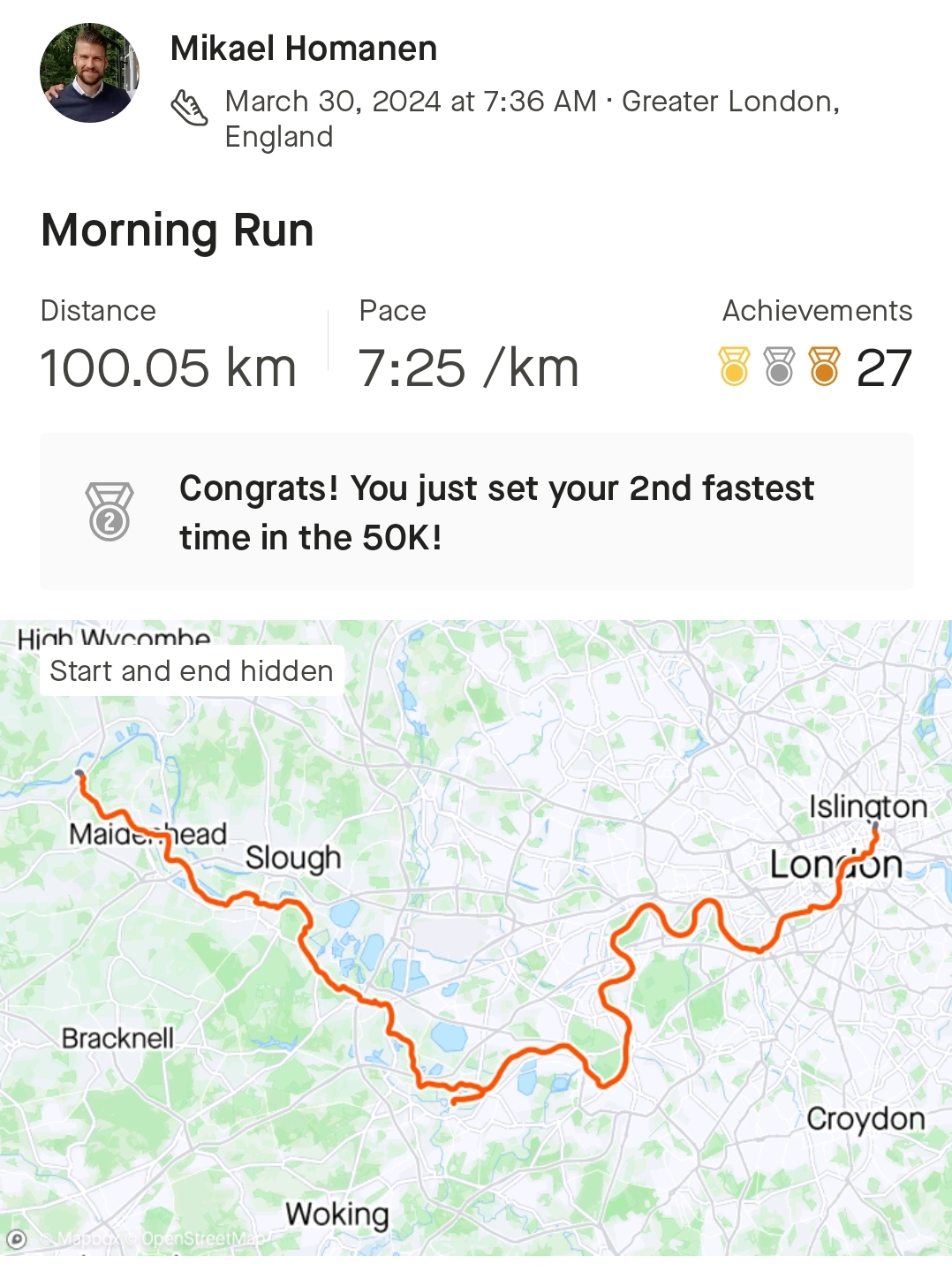
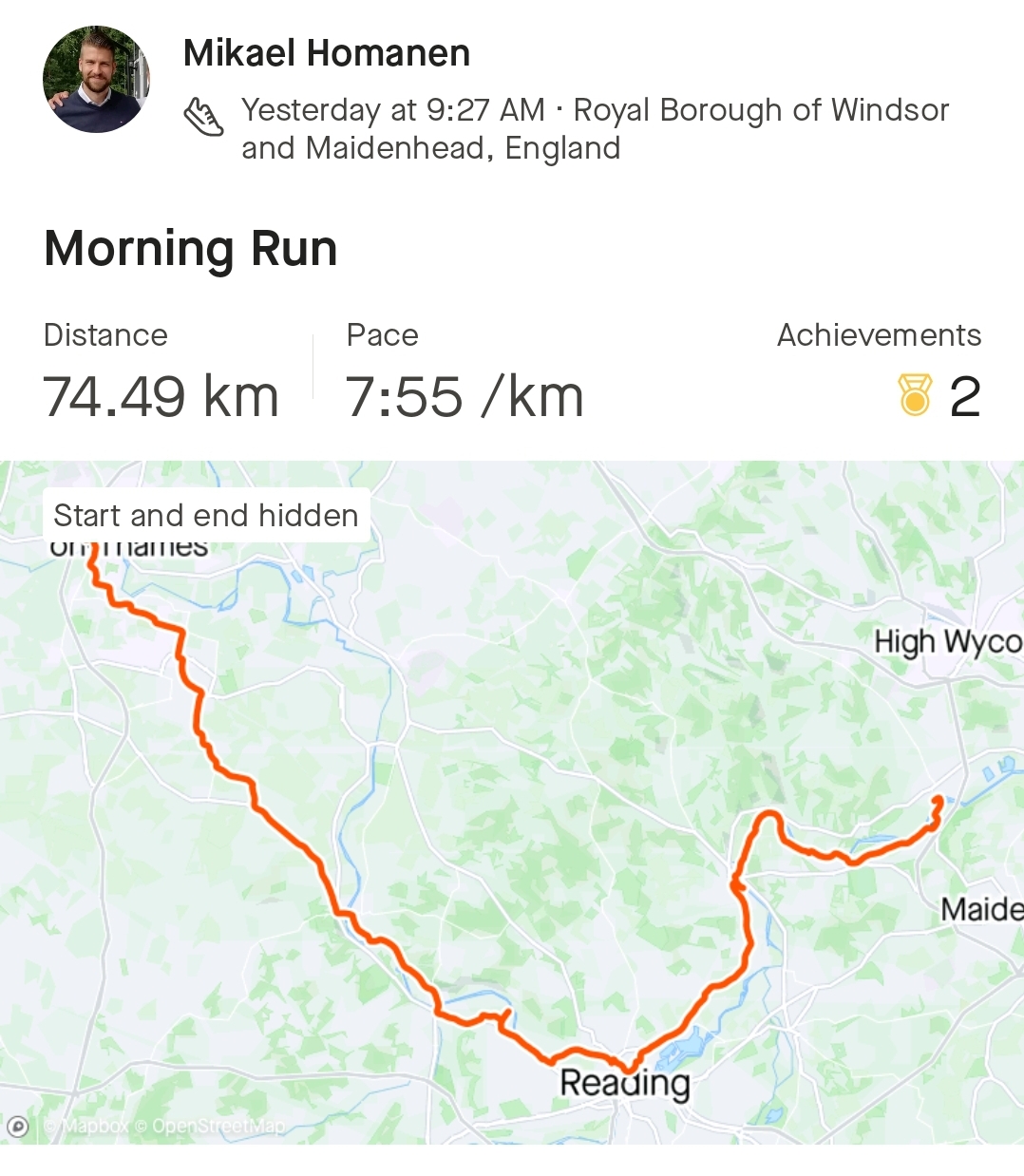
Run 200km from London along the Thames Way towards Oxford. Originally, I thought I’d run to Henley-on-Thames and back, but mid-journey I decided I’d rather just keep going along the river instead.
Highlights from the adventure:
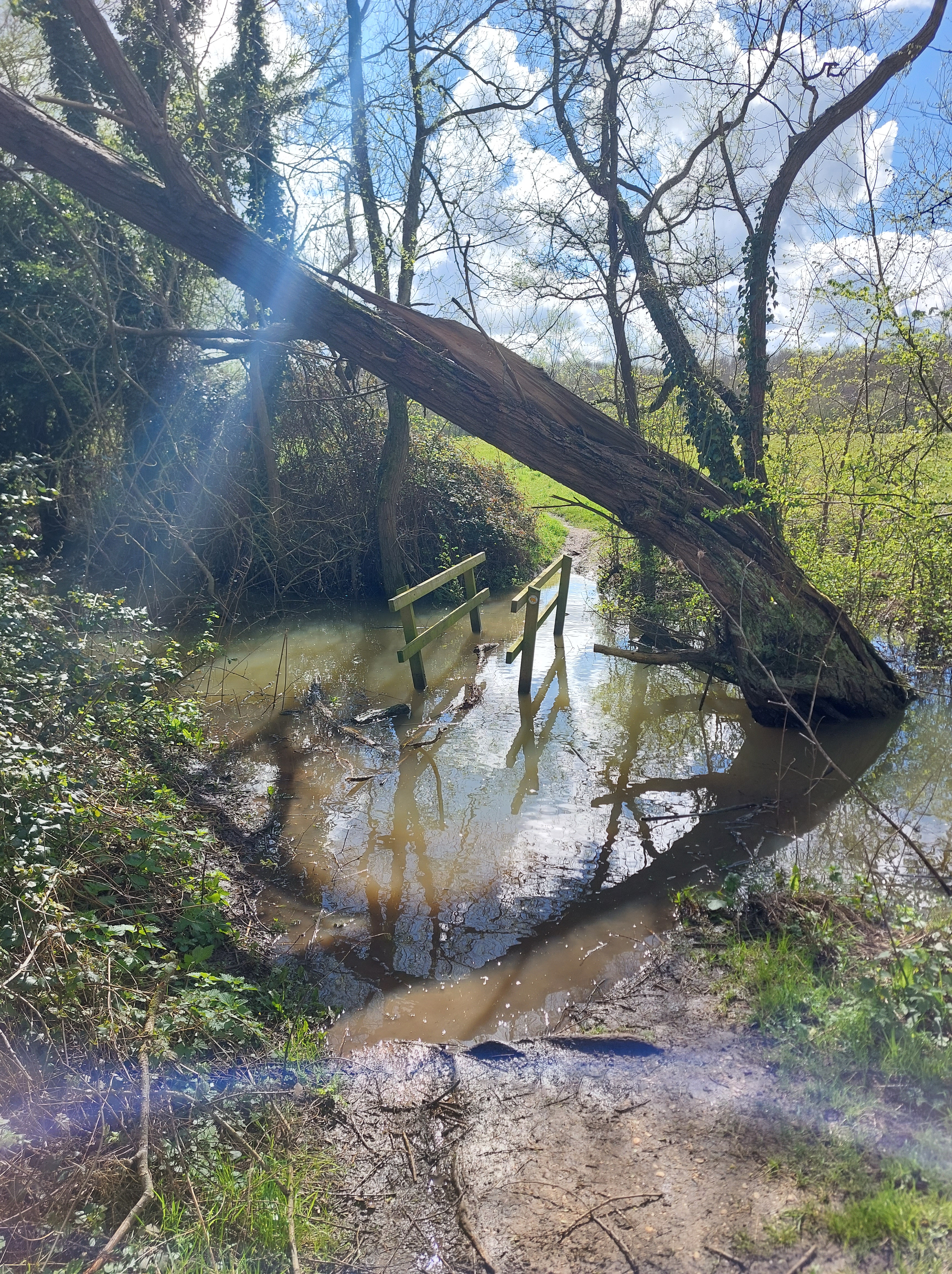
1) Flooding absolutely everywhere. This meant constant frustrating u-turns and often having to run along paths where water was nearly up to my knees.
2) Second morning, at around 130km, I accidentally joined a local half-marathon race. This gave me the exact motivation I was looking for.
3) I ran next to Runnymede where the Magna Carta was sealed. I found that thrilling.
4) Chats with locals always gave me a smile. Their reactions: “What? You ran here? From London? Why?”
5) Stayed two nights at hotels. Hotel check-in cut-offs were tough. Each time I barely made it. Also, the darker it gets, the more dangerous roads become. Sometimes, a dark, unmarked and flooded forest becomes your only choice.
6) I spent one night at the Bisham Abbey National Sports Centre. When I saw it, I had to book it. Having pictures of Olympians across the hotel rooms was perfect for the occasion.
7) I saw deer only once during the trip. It was late in the evening near a cement manufacturing plant. I was lost and I felt so was the deer. I think we both felt out place.
8) After a long day and flooded forest run, I kid you not, I fell (not so elegantly) on the asphalt 1 mile before reaching the hotel. I took a pause, kept lying on the pavement gazing at the stars and wondered to myself “what did I get myself into again”.
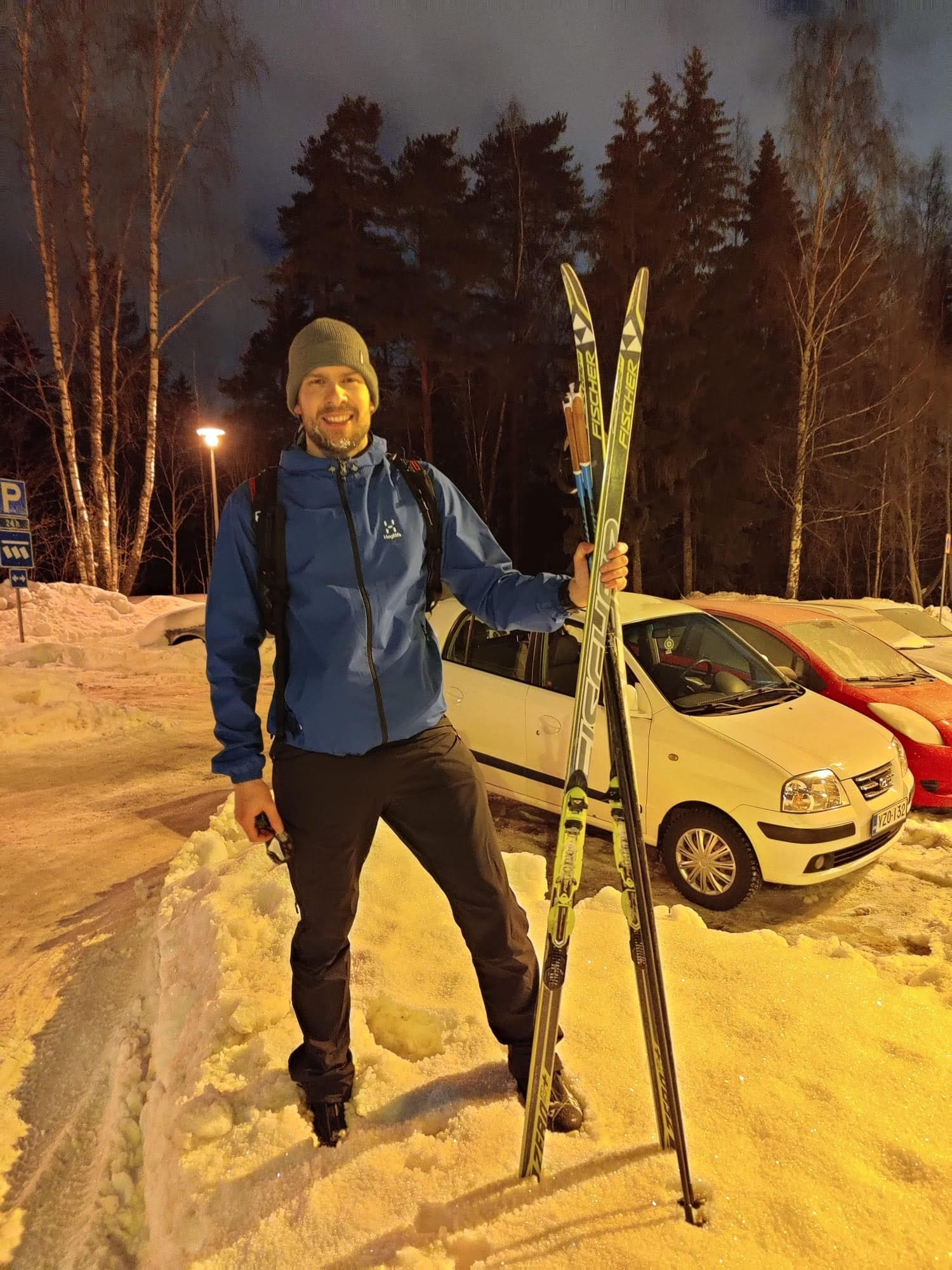
The new adventure idea was: “ok, I guess now I should ski 200km, given I completed 100miles last year”. How did I decide when I should do it? Answer: while dancing Saturday night at a wedding with a view towards a vast snowy field, I thought to myself “yes, it has to be Monday morning”.
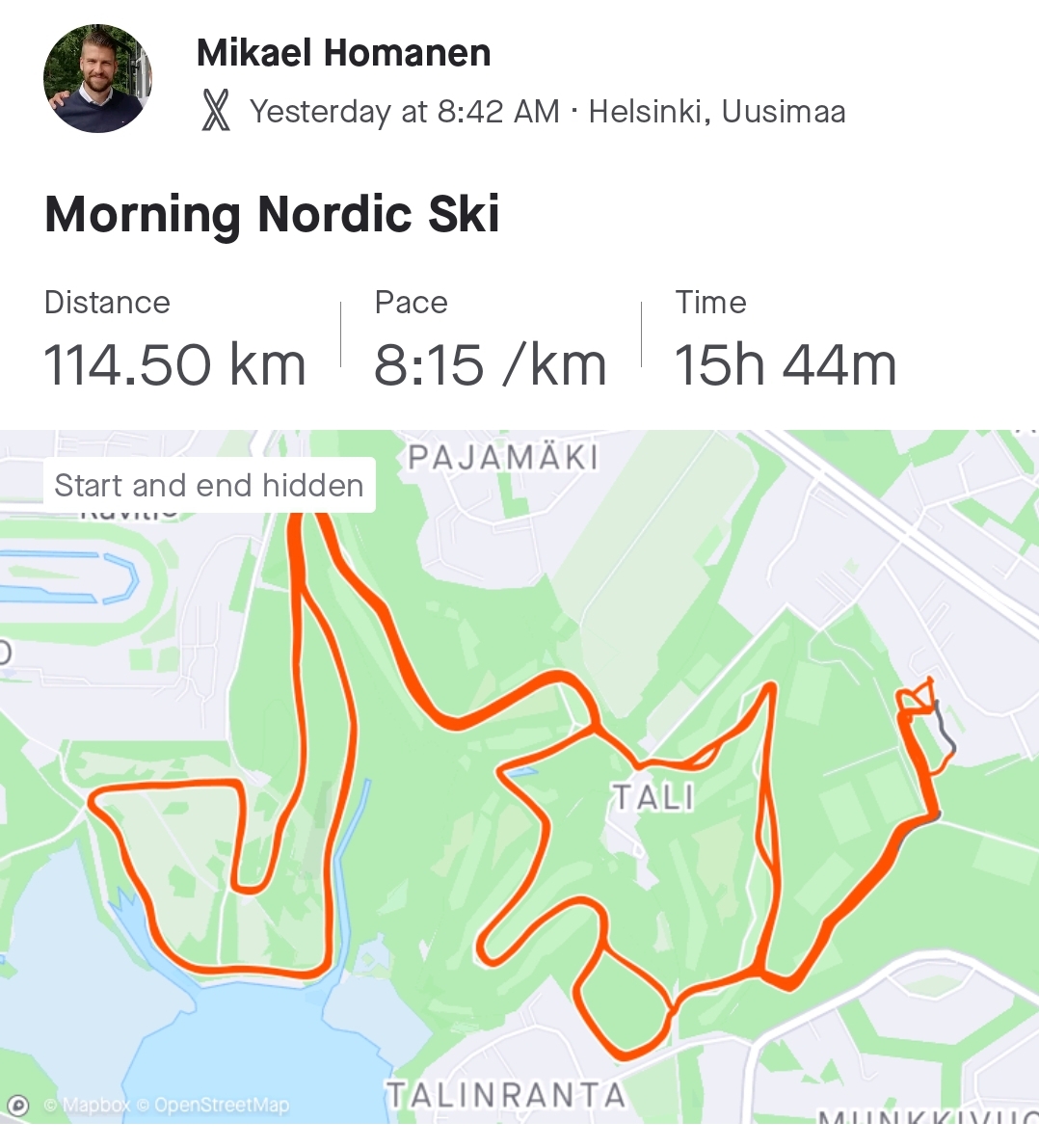
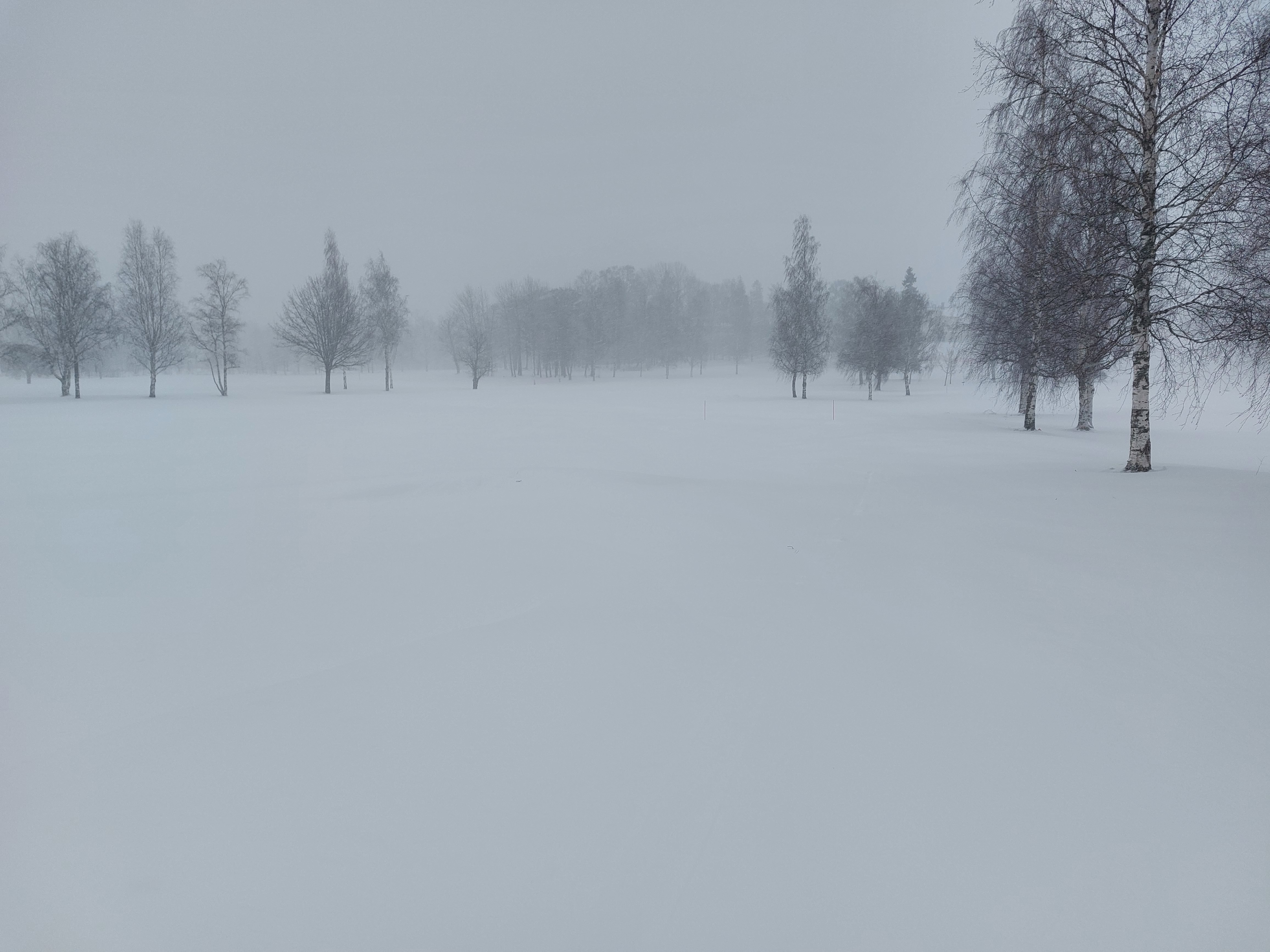
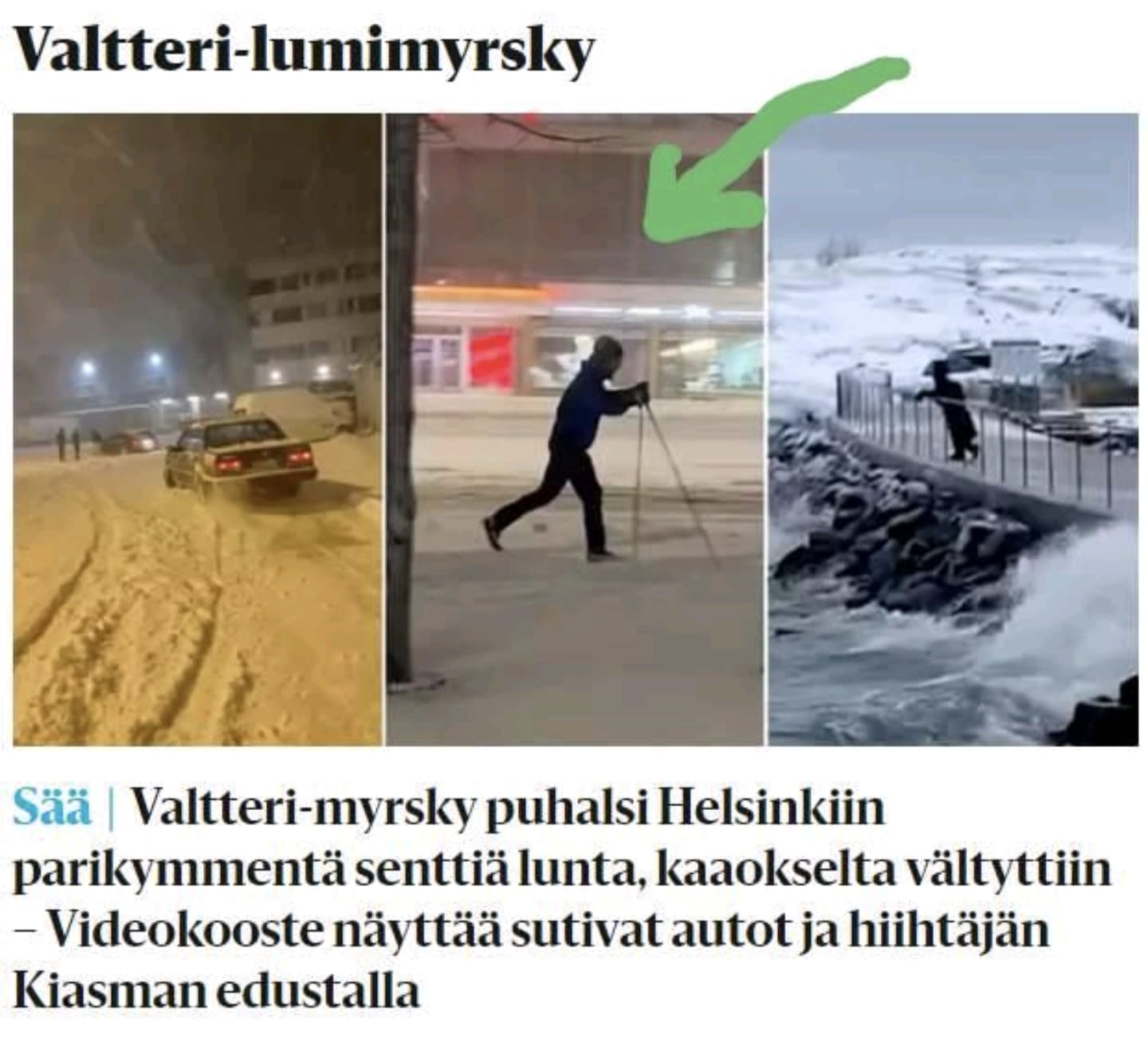
On Monday morning, I took off. I expected the idea to last a day and to enjoy a full day of skate skiing. Instead, the weather had other plans for me. It snowed heavily, and near non-stop, meaning there were no tracks to ski on. I kept moving, hoping the weather would change or the snow groomer to arrive. Unfortunately, none of these came true.
All in all, the whole adventure effectively became an off-track exercise, whereby I had to keep continuously creating new tracks as I pushed forwards. Previously, the longest distance that I’d covered off-track was 200m. The only way I could describe the process was “this is not fun at all”, with a grin on my face.
After enjoying good chats with fellow skiers, listening to a few audible books, the next day at 6am, 22 hours later, 114km of “classic” style off-track skiing I said to myself “Dear Weather, You Win. I am done”. I head home, eat pizza and collapse.
This is not a running story. It involves an ultra, but is actually focused on recovering from an “accidental mechanical burnout” (some call it digital burnout). There was no warning, it was caused by doing too many things, it was not driven by any negative stress and I was completely done. Absolutely absolutely done.
[Note – In this 9 min. blog, I’m sharing my story and in the end you’ll find my reflections, learnings and practical tips, which I continue benefiting from in my day to day]
So how did I respond? I actioned full recovery mode. 3 days in a row, I got 12hrs of sleep, 4 naps, 5 meals a day. Pizza in the morning? You bet. You’d think that that would have done the job, but no. My head was still broken and so I scheduled a vacation (or what I call rehab) for the following week to heal properly. I’ve never had this issue before and so this was all new to me. What surprised me the most was that my head would get worse on my first day off and it kept getting worse afterwards as well.
How did it get worse? Consciously I was doing all the right moves – not thinking about anything nor was I worried about anything either. This was the case for me in general and why I called it an accidental burnout. I was more or less always doing things that I enjoy or found important, though admittedly I was doing a lot of it. However, and this is where things got complicated, my subunconscioussness went bezerk by defaulting to a 110% max-gear-over-drive mode 24/7. After not taking any real time off in a very long time, my subconsciousssness got stuck on over-drive mode after the burnout. It wouldn’t stop. It was working as if it were in a crisis center, non-stop. I dont know what it was calculating but when I woke up during the nights I noticed my dreams were doing work like stuff (perhaps my brain finally solved the sustainability puzzle – who knows – with that much CPU anythings possible). No activity (e.g. reading, singing, sports, dancing) would stop it and would actually end up making it worse because the activities themselves would kick start the engine at the back (again, I have no idea what it was calculating). At some point, I ended up getting headaches by just going to the store to buy food or when someone put the TV on at the gym forcing me to leave. All of this was obviously super annoying, I enjoy everything I do. I wanted my old brain back.
How did I adapt? I went all full Buddha on this challenge, meditated a lot, did yoga with Adriene (dont get excited, I mean the youtube yoga channel), closed nearly all social media (e.g. whatsapp) and then left for Spain (I originally wanted to and almost got to go on a 8 day sailing trip, but thats another story). Overall, it was clear that the only way to stop the engine was by focused mindfullness which could be achieved by meditation, nature or by spending time with people close to me. Luckily, I got a mix of these. I ended up on the Camino de Santiago pilgrimage and running 105km with a friend. We began the journey in Sarria, talked, walked and ran throughout the night for 31 hours. There were a few interesting moments worth mentioning. For example, because my friend had a few sleepless months prior to the run, he took two 20 min naps along the route as he was about to pass out on several occasions due to sleep deprivation. Plus, he started hallucinating every now and then. I timed the naps and then woke him up. It rained during the night and it was pretty cold as well, so we had to keep moving. He also lost consciousness at a gas station at 7am, but luckily I was there to catch him before he fell on the floor (and I thought I was the one that needed help with mental challenges). Good thing the station had plenty of cookies to sugar him up. We then booked a hotel for a 3 hour nap and continued running (the hotel staff were pretty confused as we gave the keys back already at 1pm – they understandably assumed we’d stay the night). Others got good laughs before when they asked “where are you staying the night?” to which we answer “oh, we’ll just continue running”. To end, we run, walk and chat for another 12 hrs and then on the 31st hour, just 12km away from Santiago de Compostela, my friend’s ankle was done. There was nothing to fix it, and we wanted to be sure we wouldn’t cause any long term damage, so we took a taxi to the city and end the pilgrimage with drinks and laughs.
As relaxing as the pilgrimage was, my head was stilll broken. It was still calculating something in the background. So what do we do? We proceed with extreme relaxation. We take the train to Ribadavia to enjoy thermal baths, cold baths, dinners and massages. At one point, as I sat alone in the baths wondering aimlessly, I began closely examining the lines on my right hand with tremendous mind blowing awe. I thought “what a great hand” with the back engine turned OFF and voila, a real moment of relief! This was a simple first step showing that I was finally able to get my brain back. It’s a pretty strange feeling to lose control of your mind for weeks on end and then to finally get a glimpse of normality. We later head out to the coastal town of Vigo for more food and ended sleeping on a boat for 3 nights in the harbour. It wasn’t quite the sailing trip I originally had in mind, but close enough. I end the trip back in Santiago and did my best to keep eating, drinking, sleeping and calming the back engine by enjoying the town.
Overall, it took nearly 12 days to get my mind (mostly) back. Along the way, I also started getting increased clarity on what triggers the subconscious engine (burnout or otherwise) and did come to the realization that phones remain a major issue (updated thoughts below). Even though I control my phone (i.e. use it only when I want to) and receive zero notifications, the mere ability to communicate and explore options on demand is a major deterrent for concentrated deep thinking and proactive mindfullness. I am certain that I will begin taking even more formal steps to control this in the future. There is very little benefit for the social media CPU to be switched on 24/7 and instead it would serve better to concentrate on deeper and more meaningful thoughts (though still at a high pace) instead. Phones are great for facilitating curiosity, e.g. whom doesn’t want on-demand access on finding an answer to “what’s the difference between subconscious and unconcscious” (I’m still not certain I fully get it and I want to know more) but having non-stop access to check apps of interest (work, sports, news, personal network, etc.) can be paced better by choosing allocated time slots instead of filling arbitrary gaps to check them during the day. By doing so, I can fill the those gaps (e.g. bus rides) with just books and wikipedia, which is much more rewarding.
I’m pretty much all good now and back in action. That was a tough mental ultra marathon for me, huhuh. Luckily, I’m getting better and I learnt a lot along the way.
Time to get going again. I’ll just have to pace myself better this time.
Update on post above ( 2 weeks later )
I have learnt a lot from a series of post-rehab-recovery experiments. In short, the new hyper connected working environment created new (long-term damaging) norms that I had not realized. Here are the things I learned:
1) Conversational debt: Once I disconnected from social media, I had a near endless number of unanswered messages across platforms. This was the first time I realized the sheer extent of the live conversations I was having. Once remote work increased our collective use of messaging apps, I had run into debt that I was unaware of.
2) Noise: I thought I knew how to focus, but that was no longer the case. I thought I was doing 10 things at once, instead I was reacting to 10 things at once. Once the brain broke, the effects of this on my cognitive load became more visible. When I tried focusing on work, sudden updates from messaging apps were now producing clear headaches. This was a cognitive load that was actually very damaging without me noticing it.
3) Reactive work: Even though I wanted to address arising issues across messaging platforms, I did not know this was creating a new reactive norm. Once I re-adjusted my work style by allocating specific slots to messaging platforms (e.g. answer e-mails on only X hours), I realized how I had normalized reactivity. My ability to focus on one item was almost completely gone. I had to re-wire my brain to be able to focus on dedicated activities without interruptions. I was no longer choosing what I was working on, I was choosing stimulus, whether I was being distracted or not.
4) For every action, there is a reaction: I had facilitated the cognitive loads above not just on myself, but also those around me. With all the new post-Covid tools at our disposal, many of us are working on a document, while watching a seminar, while answering 5 people across 2 messaging platforms. These are great tools for short-term needs, but these are not sustainable practices long-term. This is a larger problem and I need to become more aware of my actions on others first. I need to respond, not react. With our new interactive tools, it became increasingly more difficult to differentiate these two from one another.
5) Excessive uncertainty avoidance: We answer our colleagues and friends because we want to be there for them, help and in many cases avoid uncertainty. I had not realized that because of the breath of reactive conversations I was having, my uncertainty avoidance had grown. Did I worry about uncertainty? Not at all. But was I more driven to resolve uncertainty. Yes. Absolutely. Finding resolutions to uncertainty avoidance irrespective of the horizon had become a major underlying driver of the stimulus I was searching for without me noticing it.
6) Bandwidth did not increase, only the pace: On reflection, a lot of my problems were not only due to increased workloads (there is some of that), but a lot of it was facilitating communication channels with a pace that was too high. Instead of 5 separate back and for the e-mails, it should have been just one.
In rowing, teams search for the perfect stroke. If the rate is too high, it is both exhaustive and inefficient. I share above because one should inspect their own habits first, but this should not be done in a way as if to promote that everyone’s personal struggle to resolve. You shouldn’t be expected to be solely responsible to pace yourself in a team. Therefore, let’s get out of this trap by finding new solutions to new challenges, together.
Final Update
The thoughts above were based on my immediate reflections after experiencing the mechanical burnout. These gave me a clear view of the effects of our modern short-term pressures on our cognitive overload. After months of subsequent dedication to what I called my brain re-wiring programme, I created new thumb-rules for myself to manage and take control of my brain. In this case, to take control, means taking control of ones’ own narrative, which is easy to lose when you’re note paying attention and especially in a world where information technology is pulling you in all directions. To help keep control of my own narrative, I will often ask myself the following questions.
1) Will vs. Should?
Before beginning the days’ tasks, it is important to examine how you’re describing your next steps. If you continue repeating the words “I need to do this” or “I should do this” it is likely that you’re no longer in control. Joy and productivity originate from when we say “I will be doing this”. This is ownership and ownership guarantees personal control and direction. There are many ways to re-take control and to re-set (e.g. by pausing, cancelling commitments, focused mindfulness, etc.), but asking the question before such needs arise serve as a simple and powerful test to monitor whether your transitioning from a proactive to a reactive routine.
2) Task vs. Time?
Before the age of clocks, we were primarily task focused individuals. Calendars, clocks and agendas increase the likelihood of us focusing on time instead of the completion of the tasks, which generate value for us. Therefore, by knowing exactly what you will be doing next helps take control of ones’ own narrative, otherwise the meaning of your tasks gets lost. If your immediate knowledge is knowing what you will be completing next week, such as “I will complete task X on Monday” instead of when “On Monday, I’ll be working on task X”, you’ll probably be on the right track.
3) Future vs. Tomorrow?
Do you know what you will be working on in the next three months? If not, then it is likely that a re-set is required. In such a case, it is likely you no longer have a plan that you are dedicated to and instead are working reactively, day by day. If this is the case, begin by re-planning, re-strategizing, and making sure you know, on a personal level, what you will be doing in the next three months.
4) Why vs. What?
Make sure you know why you are doing what you are doing. If you consistently fixate on what you are working on without knowing why, the work will likely soon lose meaning. Knowing why you’re doing what you’re doing is important and is key to continued commitment. Habit formation decreases our eagerness to question and ask why. Are your habits and routines still meaningful? To answer to this question, you’ll have to ask yourself why you’re (still) doing them.
5) Learning vs. Reacting?
Learning and development is important. If much of your day is filled with reactive tasks, it is time to re-evaluate and ask yourself, how can you re-build your day so that you can have a task-oriented process complemented with a developmental approach. Ask yourself, what new things did you learn or what new things did you solve last week? Answers to this question will help you evaluate the extent of your routine that is primarily reactive and non-developmental.
6) One at a time or all at once?
Compartmentalize your work. In our information technology heavy world, it is easier to fall into the trap of working on ten things at once instead of ten things one at a time. Ask yourself, how are you approaching your work and whether it is in sequence. Sometimes, multi-tasking is needed, but a sustainable long-run routine requires a sequenced approach. It is impossible to multi-task on a continued basis and therefore, do whatever it takes to make sure it is not your norm and remains reserved for cases where it is truly needed. Ask yourself, does this task require multi-tasking? If not, sequence your steps and stick to it.
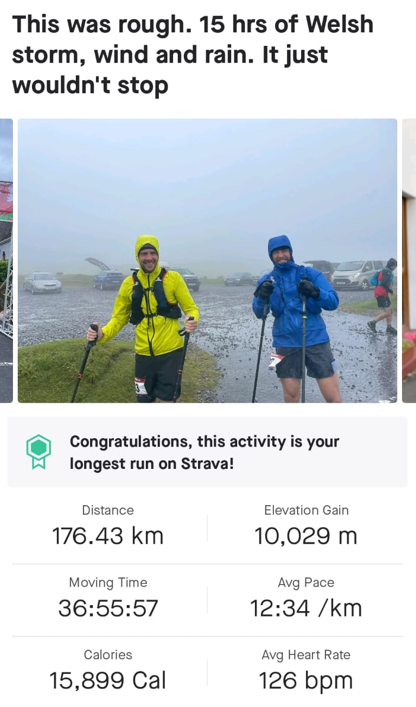
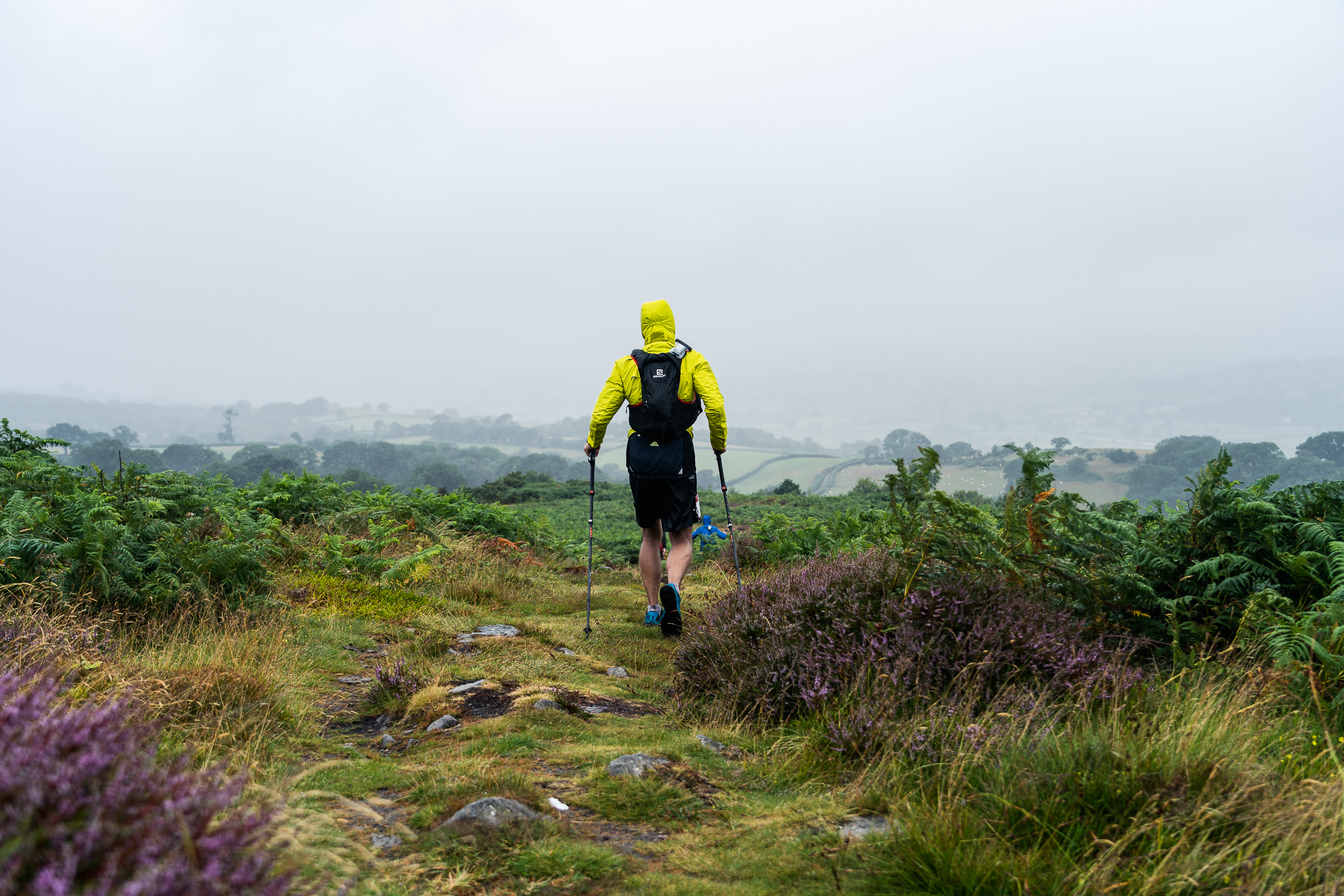
1) 37 hours of running, 6000 meters of ascent and 15 hour storm with winds that could blow you away 2) Totally not prepared, wore shorts the whole run. And, completely wrong (minimalist) shoes as well 3) At one point, we only had one device left for navigation. It was dark, windy, raining and cloudy. Much of the terrain was unmarked, i.e. barely any dedicated paths 4) Half of the participants dropped. Only 33 made it in the end 5) An absolutely insane adventure 6) This run would not have been possible without the support and help from Mario Schabus, Matthew Tyler and Kohby Poole. You guys rock!
From one idea to another. The thought process of running a half-marathon per day for 15 days to a marathon per day for 8 days.
300km
The COVID lockdown cancelled all events and races for 2020 and my 30th birthday was coming up. We were still in near full lock down, but allowed to run in the parks. So how did I decide to celebrate? By running a half-marathon per day 15 straight days straight, while still going to work (apparently the work part is what many find craziest). Finished the final run totalling 300km on my birthday, had cake and drinks with a few friends and surprisingly, it all went rather smoothly. Small note, you have to eat A LOT of lasagnes and pizzas during such events, which is great of course. Beyond some minor calf pain, and not-so-exciting-audible-books, it was all good fun (the The 7 Habits of Highly Effective People by Stephen Covey was not as motivational during the run as I thought it would be).
2. 310km
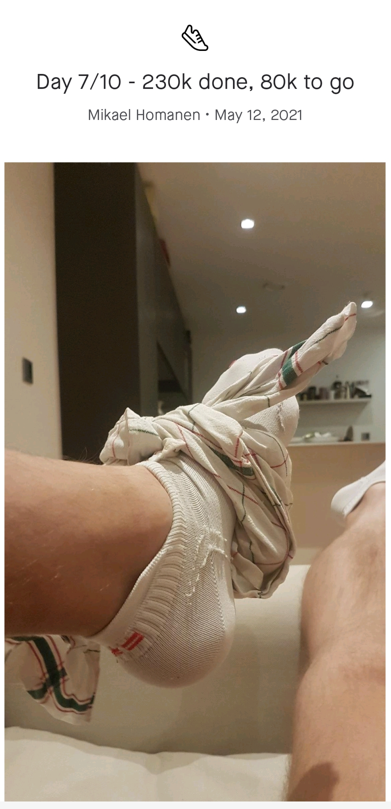
COVID lockdowns are still on and there are no events. So how do I decide to celebrate? This time, 31km per day in 10 days. I believe one of the books I was listening to was Crime and Punishment by Dostoyevsky, which was clearly not fitting for the occasion either. Beyond sub-optimal book choices and a swollen foot that was giving me trouble (see photo), it all went pretty fine. Smiles all around.
3. 320km
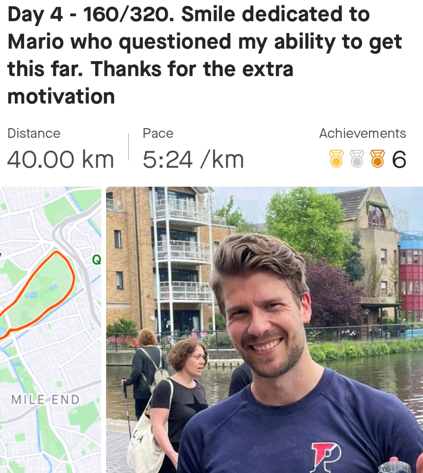
Still no races, so what do you do? This time, 8 marathons in 8 days, while going to work (again, surprisingly it’s the work part that people find intense). Best reaction from an ultra friend: “What?! You went to work this whole time?”. I also donated to Ukrainian humanitarian assistance (this was a follow-up from an earlier 50km donation run). One euro for each km. I found this important wanted to begin connecting more activities with broader goals.
Overall, things worked out fine. BUT, on day 6, things got intensely frustrating. See minutes at the bottom of the post. The details are not exciting, there are no learning opportunities. Well, maybe some, but mostly just frustrating. Ended up barely finishing on day 7 at 11pm.
By day 8, 320km was done. We celebrate, have pizzas (for the millionth time) and drinks. When it was time to head back, there was no way I was going to take a taxi and so I run a few extra cheeky kilometres back home. Also, the day afterwards, I had to go dancing for 5 hours. I had to. The ultra ended up being a bit longer than I anticipated.
Running Minutes:
1) Evening of day 6 was the best run so far. 240km done. However, equipment is failing me and phone holder breaks while running. Other than that, it was also the fastest run to date and feeling great. Only one foot hurting due to blisters 3) Arrive home, major stomach problems (sneaking suspicion of food poisoning – had awful banana, but could have been something else) 4) Using Leatherman to try and fix worst blister ever. Blister covering what feels like half a foot, plus a deep deep blister, which needed a knife to fix 5) At 10pm, I begin shaking uncontrollably, I am barely able to move. Shaking for a full hour under the blanket with barely the ability to reach out for water. Shaking is virtually uncontrollable and I am close to pulling muscles as well. Luckily, the shaking resided after an hour via some chocolate bars, water and painkiller, but very high body heat remained through-out the night. Sweating buckets continuously 6) Somehow, my phone broke during episode 5) above, absolutely no idea why. So intensely annoying. Could not reach out to friends to ask for advice. Had to use Teams from my laptop instead. I also have no alarm clock. Argh 7) Morning of Day 7, still feeling high heat, no idea why. Spent the whole night sweating, sweating and sweating. Feels like poisoning, given I am not experiencing any flu like symptoms. 8) Covid test is negative. Run to the phone repair shop and called the owner before hand. Waited an an hour at the store, he did not show up. Ran back the same night. We spent an hour fixing it and by the time I got back home, it broke again. Argh. Still no phone and not feeling great. Eating double the amount of pizzas and lasagne now, it’s became clear that episode 5) was based on not fuelling enough. Still feel horrible, but manage to finish 40km by 11pm, in the dark, at the canals with no phone. Smart 9) Day 8. Wake up, run to the electronics store to buy a phone. Apparently, they had no dedicated staff for phones, which I was fine with. I said “can I just pick one anyway” and they said “sorry, we don’t hold them on stock, you’d have to come tomorrow”. Argh. Run to another shop. Luckily, they have a phone. I then run to another shop, buy a cover and then run to another shop to buy a running phone holder. Phew. Finally, it’s done. 10) After work, I head out with a few friends and finalize the 320 km.
Step 2: Land on your right wrist, with your hand straight and have your body’s full weight dislocate your shoulder with your upper arm bone heading towards your chest
Step 3: Laugh with the good folks at Royal London Hospital on your Quasimodo lookalike attempt
Step 4: Laugh with the other goalie whom broke his arm too
Step 5: Get an X-Ray and enjoy more laughs when the personnel say “hey! aren’t you the basketball guy who broke his bones last year, stop doing sports!”
Step 6: Keep laughing. The pain gets worse
Step 7: Put some weights on your right arm and have the staff pull it back into place away from your chest, where it didn’t belong in the first place
Step 8: Take a taxi straight to McDonalds and get some McFlurries
Step 9: Question your decisions after your friends tell you they still lost the game that night
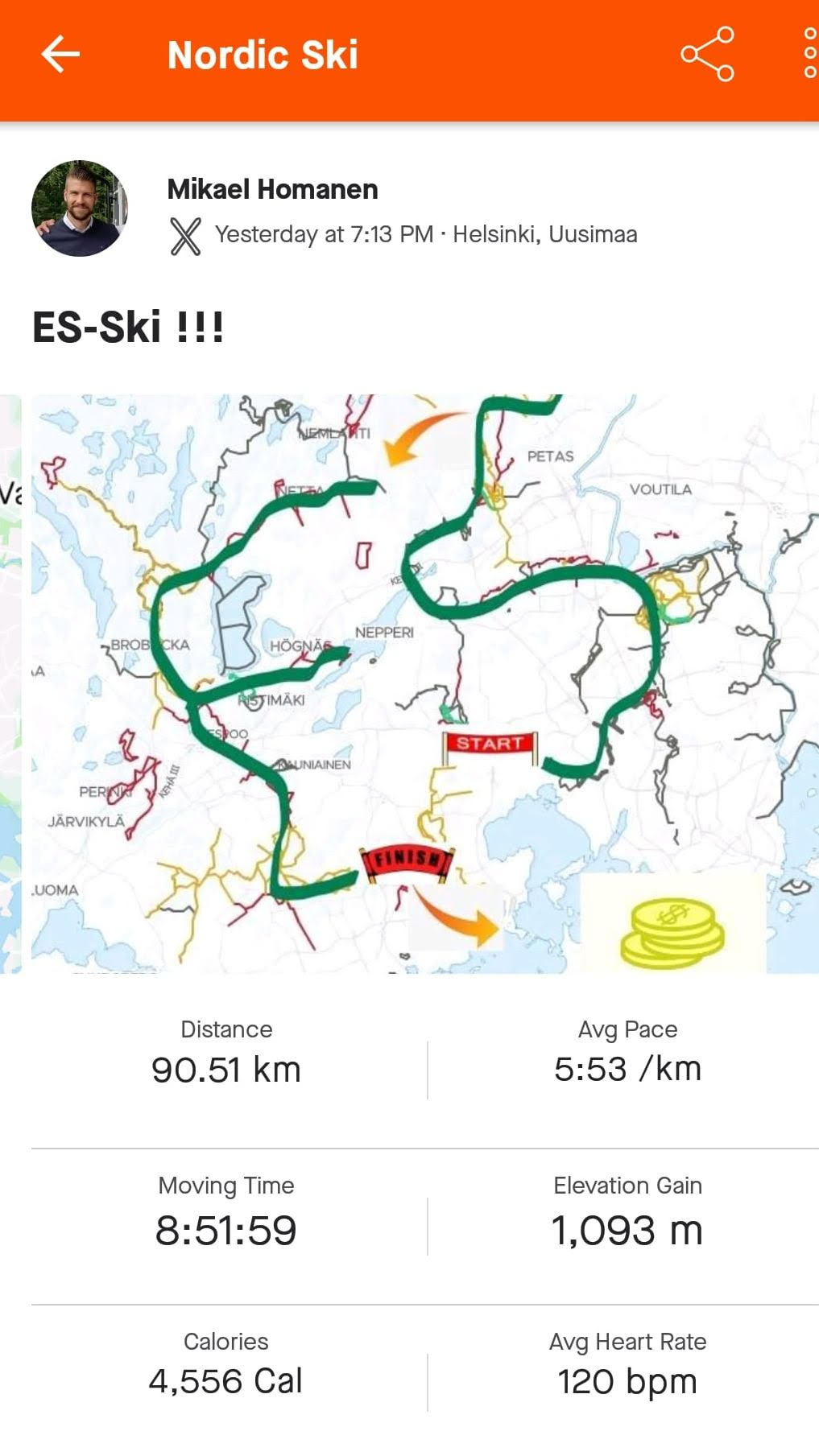
Me: I should probably ski the letters “ES” and begin the 11 hour, 90km journey on Friday at 7pm
Why? After a month of interviewing Finnish financial institutions on their sustainable investment practices, I was surprised to learn along the way that Finnish savers were not as aware of these developments as they could have
Idea: “ES-Ski”
Full Disclosure: this stunt should not be confused with the pre-existing well known Finnish energy drink “ES” meme
Complete Disclosure: this was the original idea and plan https://homanenmikael.wixsite.com/website-1, but due to last minute injuries and cancellations, alternative arrangements had to be made
More fun details:
1) Water bottles froze & with no shops around, I had to hydrate by eating snow 2) I got a brain freeze from eating snow, it hurt 3) I saw a mini aurora borealis, that was nice 4) Ran out of music, had to start singing a Finnish classic “So Good Wood” by Vesa Matti Loiri, spirits were lifted 5) Phone nearly ran out of battery due to freezing temperatures. At risk of losing my only map – I had to put my phone somewhere warm. Side note: why don’t boxers have pockets I wonder?













 Mikael Homanen